Same-Night Settlement: How Fast Vendor Payouts Should Actually Be
Slow vendor payouts cost you repeat vendors. Here's what same-night settlement looks like and how to close the books at load-out instead of next week.
EventPay Team
September 16, 2026
Vendors remember two things about your event: how the POS ran during the rush, and how long it took to get paid afterward. You can nail the first and still lose them on the second. A vendor who waited three weeks for a number they couldn’t verify is a vendor who books your competitor next season.
Payout speed isn’t back-office housekeeping. It’s a retention lever — and it’s mostly decided by choices you make before the event, not after.
Why payout speed is a retention problem
Most of your best vendors are small operators. The float between “we made the sales” and “the money landed” is real cash-flow pressure for them. When settlement is slow and opaque, three things happen:
- Trust erodes. If a vendor can’t tie your payout to their own tally, every disagreement becomes a dispute.
- Rebooking gets harder. Vendors talk to each other. “Great crowd, but you’ll wait a month to get paid” spreads fast.
- Your team drowns. Manual reconciliation turns load-out into a week of spreadsheet archaeology.
What actually slows payouts down
Slow settlement is rarely a banking problem. It’s a data problem created on-site:
- Cash in the mix, which has to be counted, reconciled, and trusted.
- Numbers that don’t agree — the vendor’s count vs. yours — with no shared source of truth.
- Reconciliation left for after the event, when the people and context are gone.
- Fees and deductions that aren’t itemized, so every statement needs a phone call.
Fix these on the floor and settlement stops being a project.
What “books that close on teardown” requires
One source of truth
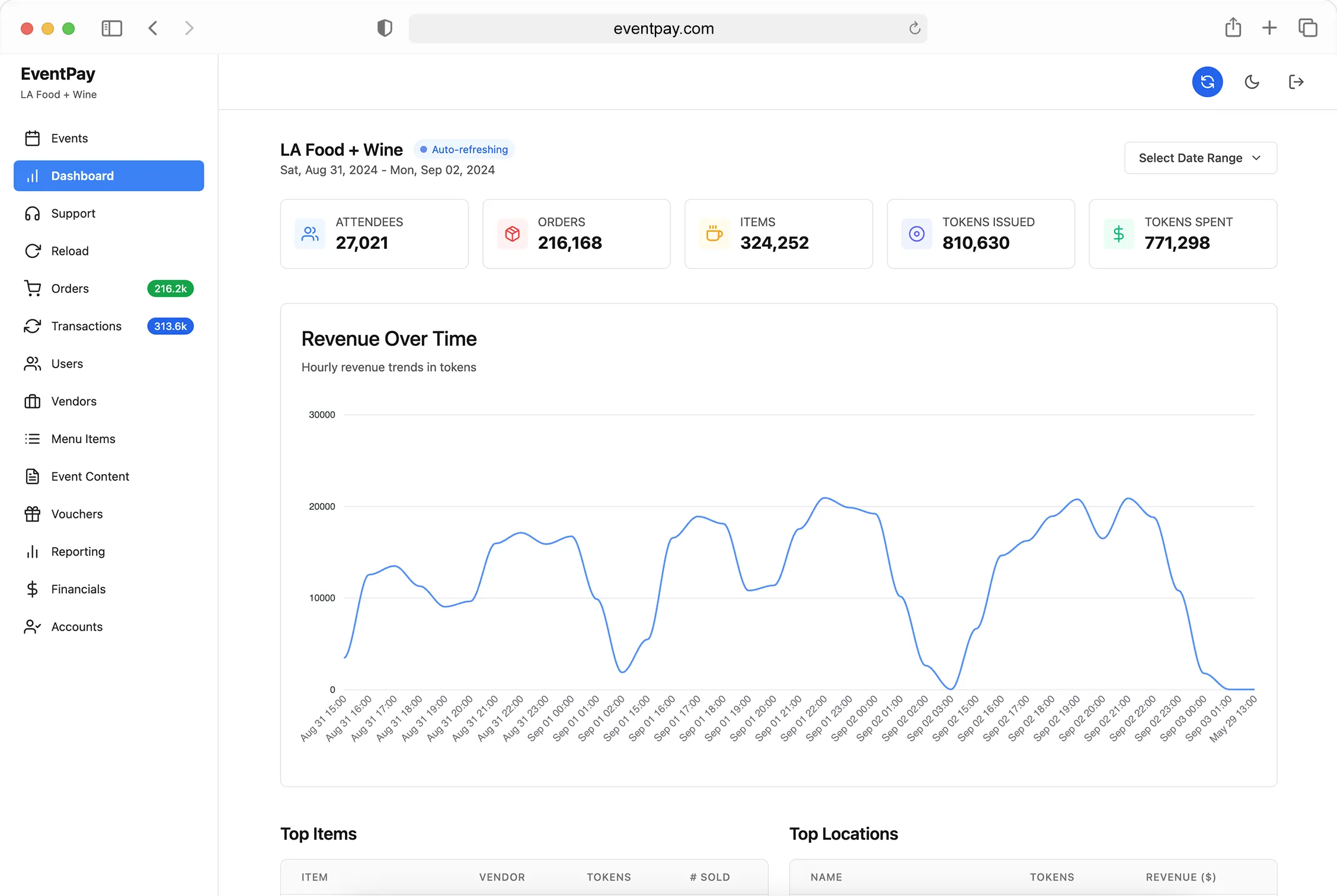
Every sale captured digitally, attributed to the right vendor, broken down by item and hour. When the vendor’s view and the operator’s view come from the same ledger, there’s nothing to argue about.
Reconciliation as you go
Sales reconcile continuously during the event, not in a batch afterward. By load-out, the numbers are already final — you’re releasing payouts, not assembling them.
Transparent fees
Processing and any platform fees itemized on every statement, so a vendor sees gross, deductions, and net without asking. (Opaque fees are also where revenue quietly leaks — see Preventing Fraud and Revenue Leakage at Events.)
Shareable statements
Each vendor gets their own clear statement — ideally a live view they can check themselves — instead of a PDF that triggers a back-and-forth.
Same-night vs. next-week
The difference isn’t just speed; it’s what your team does with the time:
| Next-week settlement | Same-night settlement | |
|---|---|---|
| Reconciliation | Manual, after the event | Continuous, done at load-out |
| Vendor trust | ”Take our word for it” | Self-verifiable statements |
| Disputes | Common, slow to resolve | Rare, resolved against one ledger |
| Operator time | Days of spreadsheet work | Release and move on |
A checklist for faster payouts
- Capture every sale digitally and attribute it to a vendor.
- Keep reconciliation continuous, not post-event.
- Itemize processing and platform fees on each statement.
- Give vendors a self-serve view of their own numbers.
- Agree on the payout timeline in the contract, and hold to it.
Where EventPay fits
In EventPay’s Studio, sales land by vendor, item, and hour and reconcile as the event runs, so operators can close the books at teardown instead of chasing them next week — with itemized fees and shareable, per-vendor statements. It’s a core reason vendor happiness depends on your payment platform.
Book a demo and we’ll show settlement and payouts against your vendor mix.